January 2019
The Other Black GirlJanuary 2019 is the epilogue’s only explicit date, anchoring its final sequence at Scope Magazine in Portland, Oregon. It places Nella Rogers at a new workplace, finishing an article about OBGs and approaching Shani Edmonds as Delilah Henson. The month matters less as a detailed chronology than as a frame for a transition: Nella imagines her article entering public circulation even as the scene turns toward a private, carefully managed encounter between two Black women who do not yet know what the other knows.
Temporal Placement and Narrative Frame
The epilogue identifies January 2019 before naming Scope Magazine and Portland, Oregon. It does not give a day, or explain how much time has passed between this scene and the events preceding it. The date therefore establishes a broad point in the story’s chronology without resolving every interval. Immediately before the epilogue, Nella looks at herself in a mirror and concludes, with despair, that the answer to the question occupying her has never been what she hoped. The shift to a dated workplace scene moves from that private reckoning to the public-facing work she is trying to complete.
The closing passage is narrated through Nella’s first-person perspective, including her imagined plans for the article and her interaction with Shani. That viewpoint makes the date feel like a moment of attempted renewal, but not a clean break: Nella is at work, with a finished draft and a future career in mind, while her next encounter carries a familiar, unsettling quality. January 2019 locates both the practical beginning of her work at Scope and the unresolved tensions that follow her there.
The Article at Scope
At Scope, Nella has spent several days writing an article that she describes as drawing on her own experience. She saves the completed draft and judges it ready for fresh eyes. Its final paragraph calls on Black women to stay focused, come together, and continue to resist. The article is thus presented not merely as an assignment but as writing into which Nella has put herself and which she hopes can speak to a much wider community.
Her next steps remain plans rather than confirmed outcomes. Nella considers sending the piece to Gwen, imagines Gwen prioritizing it and assigning another article to a different new employee, and pictures several rounds of editing, legal review, and publication online by five the following morning. She also imagines the article provoking a broad public response, bringing attention from Black Twitter, the NAACP, CNN, and Jesse Watson, and changing how Black people view one another in workplaces. Those expectations reveal the scale of her ambition, but the passage does not establish that the article is sent, approved, published, or received in the way she anticipates. In this January scene, the gap between a saved draft and an imagined public impact remains open.
The Encounter with Shani
That open future is interrupted when a woman asks where Shani sits. Reagan points her out, and the woman says Gwen has told her that Shani is working on an important article she plans to finish that day. The remark makes Shani’s work newly immediate to Nella: the article she has just completed is not the only piece at Scope carrying weight, and its progress is already part of the office’s conversation.
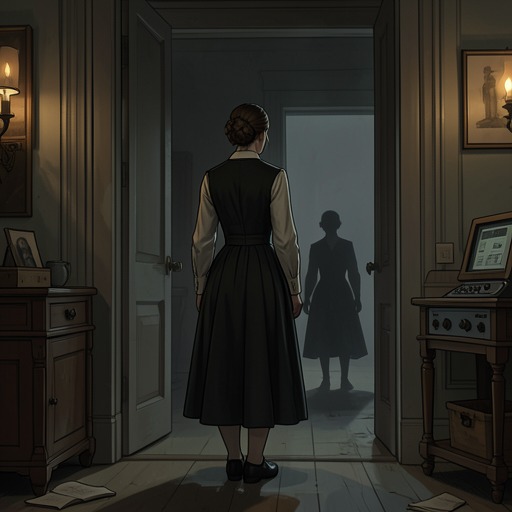
After Reagan leaves, Nella and Shani are alone. The narrative describes the woman’s polished manner and practiced tone as familiar to Shani; then Nella comes closer and puts a cool hand on Shani’s shoulder. Speaking as Delilah Henson, she invites Shani to speak candidly. The exchange brings the epilogue’s larger temporal contrast into focus: Nella has entered a new professional setting and completed an article about OBGs, yet the encounter echoes the very tensions that article addresses. January 2019 closes the novel not with a confirmed publication or resolution, but with Nella poised between imagined public exposure and a private conversation whose consequences have not yet been shown.